







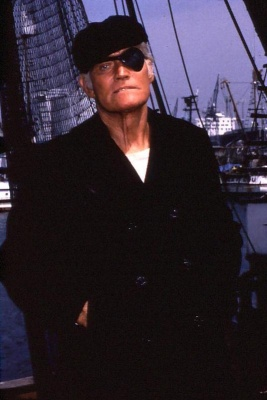
Bio Chuck
Character: Janos Skorzeny
Chuck Connors attended Seton Hall University before embarking on a career in professional sports. He first played professional basketball with the Boston Celtics, then transitioned to baseball with the Brooklyn Dodgers and Chicago Cubs. Though not a standout player—he batted .233 in 70 games with the Cubs—Connors was eventually sent to the Chicago Cubs’ Pacific Coast League affiliate, the Los Angeles Angels. There, his reputation stemmed as much from his playful on-field antics as from his athletic ability. During one of his trademark cartwheeling routines while rounding the bases, he was noticed by a Hollywood director who soon cast him in a brief bit part as a highway patrolman in the 1952 Tracy–Hepburn film Pat and Mike.
Finding acting both agreeable and less physically demanding than professional sports, Connors left baseball to pursue a career in film and television. Early on, he made an impression as a comic hillbilly in the memorable Superman TV episode “Flight to the North.” In feature films, he frequently portrayed tough or villainous characters, including the gravel-voiced gangster Johnny O in Designing Woman (1957) and the swaggering bully Buck Hannassy in The Big Country (1958). His image shifted in 1958 when he took on the role that would define his career: Lucas McCain, the principled frontiersman and devoted father in the hit TV western The Rifleman.
During the show’s successful five-year run, Connors continued to build his film résumé. He appeared in the title role of Geronimo (1962)—co-starring with his second wife, Kamala Devi—and originated the character Porter Ricks in the 1963 film version of Flipper. After The Rifleman ended, Connors moved into the 90-minute dramatic series Arrest and Trial (1963), co-starring with Ben Gazzara in a format that presaged today’s Law & Order. He followed this with a well-received turn as Jason McCord, an Army officer wrongly accused of cowardice, in the western Branded (1965–66).
Connors’ subsequent series, Cowboy in Africa, lasted only thirteen episodes, but he remained a familiar presence on television. In 1972, he served as host and narrator of the syndicated documentary series Thrill Seekers. Numerous guest appearances and roles in B-movies—including the cult favorite Tourist Trap (1980)—followed. He delivered one of his most memorably flamboyant performances as the eccentrically accented, 2,000-year-old lycanthrope Janos Skorzeny in FOX’s Werewolf (1987–88).
Near the end of his life, and shortly before his death from lung cancer at age 71, Connors reprised his iconic role of Lucas McCain in the star-studded TV western The Gambler Returns: The Luck of the Draw (1993).
Behind the Scenes
The following account explains what occurred with Chuck Connors during the production of Werewolf and why a stand-in appears as Janos Skorzeny after Episode Nine. The information comes from Steve Stevens, Connors’ agent for 18 years.
When Connors was first approached to portray Skorzeny, he requested a specific per-episode salary. The producers agreed, but Connors also stipulated that if the show were picked up as a series and proved successful, he expected an increased rate. Producer John Ashley objected to this arrangement and decided to write the Skorzeny character out of the developing series. As a result, the role did not progress beyond the initial appearances.
The production later invited Connors to participate in a two-hour movie intended to gauge audience interest and determine whether Werewolf would move forward as a full series. Connors was offered a substantial sum for the film and asked to review the script before committing further, especially if the series continued. However, the producers envisioned Skorzeny as a weak, subservient character—one who would cower before the more dominant werewolf, Nicholas Remy (played by Brian Thompson). Connors felt this portrayal was inconsistent with his image and would not be well received by his fans, and he declined to participate.
The producers then used a stand-in to impersonate Connors’ character. When Connors and Steve Stevens learned of this, they took legal action against John Ashley. The Screen Actors Guild (SAG) became involved, noting that producers are required under SAG contracts to negotiate with an actor before using their likeness, footage, or related material. SAG ultimately awarded Connors a settlement as compensation for the unauthorized use of his character’s likeness.


